Sunday, 10 March 2013

Dispatches from the edge of life

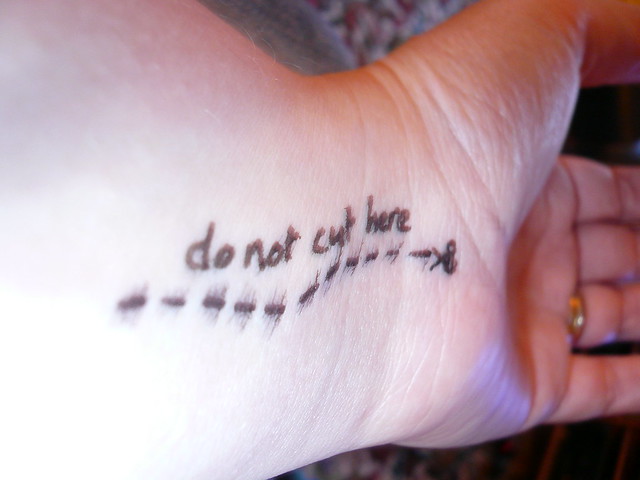
do not cut here  -----------


My words are going to be published in a book. Two thousand and nine of my words to be precise. They form a chapter entitled 'Semi-suicidal' which will appear in a book called 'Our Encounters With Suicide' later this year. I have always wanted to be a published author ... how strange that the lowest point of my life so far would be the inspiration for those words. I'll hopefully be able to share more of the chapter with you once it's been published but in the meantime here is the opening paragraph {Spoiler alert: I survive}:

"I am standing by the sink in our kitchen. I am holding a knife in my right hand. I am pressing the very tip of the blade hard against the artery that runs up my left wrist. I want to puncture the vein and let some blood flow but my skin is unyielding and resists my efforts. I am not trying to kill myself but a part of me wants to know how easy it will be to slit open that vein if I do decide to die. I’m disheartened to discover that it will be much harder than I have imagined."

Monday, 18 February 2013

Forty Days of Silence, or 'why I've given up tweeting for Lent'

I'm in danger of becoming a bit of a silence bore [exhibit A, exhibit B]. Luckily for you I'm only on day 5 of my 40 day twitter silence so my opportunities to badger you about it are somewhat limited until Easter arrives. But while I have your attention, let me tell you about silence and why I've given up tweeting for Lent.

For the last 18 months or so I have been anything but silent. First I broke my silence to a therapist, then to close friends and family, then to my GP, then to my managers at work, then to more friends and family, then to the kind staff and volunteers at the Maytree sanctuary for the suicidal, then to a room full of near strangers, then to the whole internet via my blog and twitter.

And then I realised that breaking my silence about depression and suicidal thoughts wasn't going far enough ... so I broke my silence on physical and emotional abuse, first to the world via my blog and twitter, then to my mum (hardly the ideal order to break the news but that's the order it happened in).

And then I ranted and raved on twitter and set out my vision for a kinder society. And then I ranted and raved a bit more.

why hold on with tears in our eyes?

And I found myself wondering whether all my silence breaking had really changed anything. And I wondered how many other people's stories need to be shared before anything changes. And that's when I thought I'd stay silent again instead and see if people would react more to my public silence than than they had to my public silence breaking. Putting it simply, I decided to yield the floor and stop talking about silence for a while to see what happens when I stop speaking up.

The main aim of my 40 day twitter silence is to raise awareness of silence and how it adds to the stigma experienced by abuse victims and those suffering from mental health conditions such as depression. If you'd like to support my 40 day twitter silence you can do that by sponsoring me or by simply talking to those in your immediate family and circle of friends about their mental health. The money you donate will go to the Maytree respite centre who helped me find my way back to the land of the living last year.

I'm not undertaking this twitter silence as a digital detox so I'm still looking at twitter and I'll be sending very occasional DMs to close friends. If that feels like I'm cheating then I'd like to politely suggest that you embark on your own twitter silence and make the rules for that as rigid as you'd like them to be ... and let me know about it so that I can sponsor you :-)

So anyway, enough words from me, please visit my Just Giving page and make a donation if you can spare the cash - but more importantly please talk about silence and get the support you need to break your own silence.

Saturday, 16 February 2013

It's time we talked about silence

We need to talk about silence. We need to talk about the way that silence kills loved ones. We need to talk about the way victims who break their silence find themselves re-silenced or turned away from. We need to understand who benefits from silence and who suffers. We need to notice the moments when we stay silent and uncover why we were so afraid of speaking that we swallowed down our words. We need to take individual responsibility for the times we silence other and the times we silence ourselves. We need to talk about silence. Let me start by telling you about mine.

My silence started young. In fact it started at birth when my twin sister and I arrived in the world two weeks early and I was born with 'primary atelectasis' (or 'lazy lung syndrome' as I prefer to call it). I don't know if military hospitals are particularly overcautious but before our mum had even woken up from surgery I had been baptised by the military chaplain. I'm not sure if I was put on a ventilator but if I was then I would have soundlessly been crying. In any case I almost certainly did not come out of our mother's womb with the customary vagitanus screams of a new born infant.

And then my silence deepened. My twin sister and I were in the neonatal intensive care unit for the first two weeks of our lives. I've only read fairly recently that a crying newborn will stop crying out within a matter of days if they are not attended to. That certainly sheds new light on our mum's observation that we were exceptionally well-behaved babies who very rarely cried throughout our early infancy. And I've also discovered over the past year that my challenging entry into the world, together with the impact of other traumatic childhood experiences, not only meant I was predisposed to becoming a future victim of abuse from day 1 but also that my life quality and life expectancy were somewhat dented from that moment on.

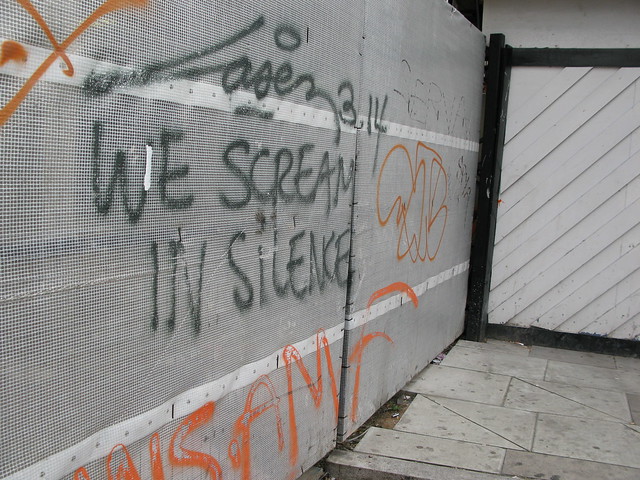
 we scream in silence

And so my silence continued through childhood. No one really even had to tell me to be silent, a single glance from an irate adult and I effortlessly silenced myself. But I also found ways to speak up ... unfortunately they were silent screams in a world that doesn't want to hear the voices of those who are suffering. Headaches, sleep walking, sleep talking, earache, sore throats, ravenous reading, fainting without warning, excelling at school, fitting in, seeking sanctuary and respite in the school sick bay and our local library. My school reports largely comment on what a "pleasant" child I was. But early on a teacher venomously asked me if I knew the meaning of  the word 'hypochondriac' and other teachers made it clear that I was trying too hard and my raised hand in class increasingly went ignored 'to give the other children a chance'. As the years went on I stayed silent through emotional abuse, bullying and intimidation. I stayed silent on the outside and put all my energy into trying to make sense of the world I found myself in on the inside. Tears and words swallowed down as easily as aspirin.

Through the eyes of a child my silence makes complete sense and, even though it didn't always keep me safe, it did keep me alive - even if I was simply surviving rather than thriving. Looking back now it is the silence of others that I find the silence of others most shocking. The doctor who diagnosed me with tension headaches, the teachers who didn't ask why I was trying so hard and worrying so much, close family who didn't ask my stepfather why it was necessary for young children to eat every meal in complete silence. And in recent years those who have responded to the news of my depression and anxiety first with sympathy and then with untold personal stories of their own suffering in silence. And also the silence of my current GP and the healthcare profession as a whole who seemingly have not once thought to tell me that the circumstances of my birth alone left me vulnerable to a profound sense of aloneness that would be very likely to lead me early to my grave, either at my own hand or as a result of the ghostly shadow my "early life adversity" is likely to have cast over my nervous system, my brain and my heart. It seems strange that when interventions to tackle the damaging after-effects of early adversity were first being rolled out, no one thought to ask 'and what of the walking wounded, the spirit murdered and those who harbour a terrified child within their soul? What of the damaged parents who will be taking these newly protected children home? What can we do to heal them? And what cost to humanity if they continue to roam the world unhealed?' Silence is met with deeper silence.

Silence told me I would be safe if I didn't talk back and that even rolling my eyes was a crime against my stepfather's authority. It told me that I was wrong to trust my innate sense of injustice and that I should ignore the swallowed down fury that made my throat hurt and my bones shake. Silence told me that the sky was not falling in and that threats to my safety came from strangers, not in my home. Silence told me not to shout for help, not to raise the alarm and not to cry unless I was alone. Silence told me I was invisible and that no-one was listening to my screams. Silence told me everything was okay. Silence became my home and silence nearly killed me.

I appreciate that my words above are veering dangerously close to being hyperbolic and maybe I am grossly overstating the risk. Maybe I'm not a fragile ticking timebomb after all. Maybe I should just shush up and get on with forgetting about the past. But the very fact that it feels like that's exactly what everyone hopes I will do makes me convinced that it's the last thing I should do. Maybe the new early life interventions will break the cycle of domestic violence, child abuse, rape, murder, poverty and despair ... or maybe we need to collectively break our silences and learn how to offer and receive solace rather than outsource our compassion to charities, experts and pharmaceutical companies. Maybe then we will stop having to bury people for the want of a shoulder to cry. Maybe then we can sit with our own suffering instead of reaching for the knife drawer, the wine bottle, the sleeping tablets or lashing out at our kith and kin, destroying someone else's sense of safety and security or travelling half way across the globe to lawfully murder other people's sons and daughters. Maybe then we'll see silencing ourselves and others as the most dangerous form of violence there is.

"Before you can exploit others you have to silence them." - Derrick Jensen


Saturday, 8 December 2012

The paralysed heart, the arrested soul

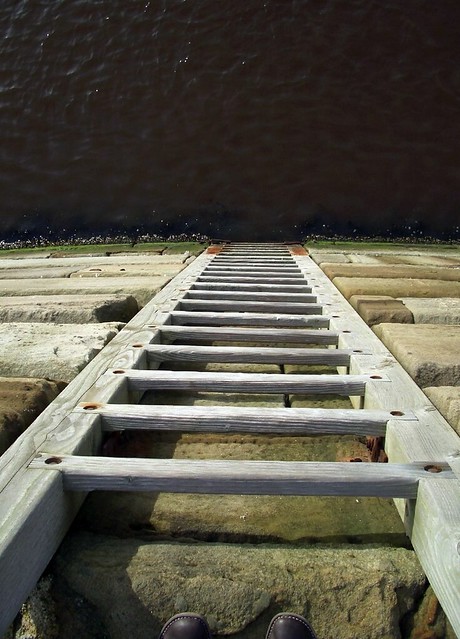
ready to jump

In my last blogpost I spilled my guts about things from my past that may have contributed to my descent into depression and suicidal thoughts. I also promised to share the legacy of those experiences - So in this blogpost I'm going to try and explain how my childhood experiences continue to reverberate through the years with some lightly sketched vignettes taken from my life:
  • It's September 2002. I'm standing bolt upright on a paddle board which is floating on the still waters of a small breeze-less bay in Skyros. I am desperately trying with every fibre of my being to either return to a sitting position or jump into the water but I can't bring myself to do either and I am rooted to the spot. I don't feel scared, I just feel ridiculous and aware that Mark (my then boyfriend, now husband) is getting increasingly angry with me. He's not angry because I can't jump, he's angry because my board is slowly drifting out to sea and out of his reach. I am frozen to the spot but his protective anger and worry finally gets through to me - I hesitantly make it down onto my knees, then into a seated position and we paddle back in near silence. Strangely, a friend who is watching from the shore, later tells me that to her I looked like a statue of the goddess Athena - gracefully floating towards the horizon with an air of aloof confidence.
  • A few years later I find myself standing in the reception area of a residential training college. It is late o'clock and I've left the bar so that a colleague can teach me to juggle, which I have always wanted to do but somehow never managed to. He hands me three juggling balls but, despite his gentle coaching and cajoling, I cannot bring myself to release any of them into the air. My colleague takes away one ball but still my hands and arms remain frozen and neither of the remaining balls makes it into the air. We are both laughing and I am convinced that any second I will release my grip on one of the balls. My colleague chuckles and, with a well-natured but despairing shake of his head, takes back a second ball. I am now standing with a single juggling ball in one hand and my other hand is empty, ready to try and catch it. Except I never manage to release that final ball into the air despite several minutes of my brain imploring my hand to 'just throw the jeffing ball already'. Our drunken laughter escalates into bewildered giggling at the absurdness of the situation we find ourselves in and I gradually deteriorate into teary hysterical laughter. My colleague accepts that his juggling coaching skills have met their match and we head back to the bar.
The scenes I've described above were not just real-life experiences - they also metaphorically represent a deep level of stuckness in my life ... I have a pervasively liminal feeling, like I am always on the edge, on the cusp, on the verge along with a sense that there is an invisible force holding me back from making progress on hopes and dreams that I rarely dare to consciously articulate. Earlier this year I was watching a PBS documentary called 'Forgiveness: A Time to Love and a Time to Hate' and one of the stories hit me like a thunderbolt. I was listening to Terri Jentz talk about her horrific experience of being attacked while camping with her college roommate and as she described the impact the single brutal trauma had on her life many years later:
"I had a feeling of stuckness, of paralysis, a loss of concentration, a seizure of my ordinarily unflappable will. Something was different. And with each passing year it got worse. [...] I began to fear everything. My body was afraid of being crushed by a vehicle. I had apocalyptic fears. I felt like I had to split into a kind of wildly overreacting, intensely emotive, even manic, self. And then I would just switch. like that, into a completely numbed out, deadened version of myself that was just kind of asleep, narcoleptic. Some invisible, hampering paralysis had set in. It was as though my ability to take my destiny in hand had been wrested away from me. [...] I wasn't aware of the anger I was carrying [...]. I had to confront the trauma in order to be free."
The whole documentary is worth watching but the section featuring Terri Jentz and her roommate can be viewed below:

         Watch Language of Anger on PBS. See more from Forgiveness: A Time to Love and a Time to Hate.

The fact that I could resonate so strongly with how Terri felt in the years after the attack shocked me - I still don't understand it at an intellectual level but that resonance was the start of me beginning to face up to the fact that the net result of the traumatic experiences of my childhood was, in some crazy unfathomable way, equivalent to being run over by a truck and threatened with an axe. I still can't quite comprehend how the childhood experiences I spent my whole life dismissing as normal or insignificant had been so damaging to my innate sense of safety. But hearing Terri talk was like hearing my own thoughts verbalised so I couldn't easily dismiss the realisation and, although I still have moments where I worry that I'm making a fuss over nothing or blaming my own inability to take action on a sob story from my early years, I know that that unexpected and incomprehensible recognition of the impact of my childhood experiences has been an important part of the healing process and a represented a watershed moment that, hopefully, will ultimately allow me to free myself from the invisible hand of my past and move forward to finally take centre stage in my own life.

Sunday, 11 November 2012

Breaking the silence beyond silence

As I sit down and start typing this blogpost my heart is racing, my palms are sweaty, my stomach is churning, my brain is crackling with fierce static and my fingers are trembling on the keyboard. I'm not sure I'm going to be able to express myself properly but I feel a need to say something, no matter how much I stumble over the words.

In writing this blogpost I'm keeping in mind a couple of tweets I, somewhat serendipitously, read this morning. The first is from Anthony Lawlor who said "In all the truth speaking, what goes unsaid reveals the most." And the second is from Teresa Robinson who shared a quote from Anne Lammott: "You own everything that happened to you. Tell your stories. If people wanted to write warmly about them, they should have behaved better."

The fact that I feel so fearful about writing this blogpost speaks volumes - particularly considering I have previously blogged about my, too close for comfort, brush with an eating disorder, and my, even closer for comfort, brush with suicidal depression - You would think that there are few shadowy areas of my life left to reveal to the glaring light of public disclosure ... but you would be wrong.

Over recent days, weeks and months it's fair to say that the UK has been rocked by a stream of shocking revelations regarding child abuse. As each scandal broke I watched the folks in my twitter stream reacting with righteous indignation and disbelief. And I gradually realised that two things seemed to be largely missing from the media coverage and the comments on Twitter. The first was recognition that the abuse cases being uncovered are exceptional, albeit no less horrifying, occurances and that the vast majority of abuse happens not in a celebrity's changing room or in a care home, but in ordinary family homes in our own villages, towns and cities. Statistics on the NSPCC website state that 1 in 4 people experienced sexual abuse as children. Most children know their abusers and 80% of offences happen in either the child's or the perpetrator's home. In other word it is not just aged television presenters, pop stars and MPs who will be feeling uncomfortable as new disclosures about abuse come to light. One exception to this lack of recognition was Anna Nathonson's piece in the Independent which was the first time I'd read the 1 in 4 statistic.

The second thing that was even more absent, in fact completely missing, was anyone putting their hand up and identifying themselves as a victim of abuse. This heavy veil of silence is a clear indicator to me that being a victim of abuse carries with it a massive burden of stigma. A few weeks ago I came to the personal realisation that although I had stepped forward and broken free of the stigma around suicide and mental illness (yay, go me!) I was still gagged and bound by the chains of the stigma attached to the contributory causes of my mental illness. I have spent a lot of time trying to work out how I could broach the subject of this double stigma without sharing any of the details of my personal experience. I'm feeling very dizzy and heavy-skulled as I type these words ... it seems to me that I probably cannot very easily do one without the other.

It feels unfair to me that having broken the silence once I now find myself needing to do it again. At least with my disclosure about my suicidal depression there was a happy ending - my personal experience of abuse and neglect is nothing but messy, shame-ridden memories which will no doubt deeply upset my close family and friends, and very possibly break my mum's heart. In the face of that, keeping silent seems the much easier path but the cost of that silence has been too high already - my ongoing mental health problems and recent suicidal episode (which I now realise was the result of 'double depression') is directly related to my early childhood experiences and further exacerbated by experiences throughout childhood and into early adulthood. It is still very hard for me to accept my depression and my ongoing issues with anxiety as a mental illness - it just feels like the result of me not being very good at being human. At the same time I also struggle to reconcile the relatively low level abuse and mistreatment I experienced with the severity of the impact to my personality development and mental health - the result seems disproportionate to contributory factors. In all likelihood this is largely due to a failure on my part to accept the severity of those contributory factors, underestimate the impact it's had on my life and a failure to appreciate the complexity of those factors acting on top of each other over time.

By now your imaginations are probably running overtime so I'm going to share my experience as undramatically as I can - It would be inappropriate to share the full details but here are the main 'highlights' of what I experienced:
  • multiple experiences of, relatively innocent, sexual contact at the hands of boys who were the same age or a few years older than me from about 5 years old through to puberty.
  • being 'flashed' by a stranger in an underpass on the way home from school, aged 11.
  • inappropriately early exposure to pornographic magazines and horror movies.
Other factors played their part too:
  • when I was born I nearly died and my mum didn't see me or my twin sister for several days after we were born - I then had to stay in hospital for a couple of weeks after my mum had been discharged (they kept my twin sister with me). Interestingly my therapist informs me that children who experience early periods of hospitalisation/maternal separation are more likely to be abused.
  • my parents split up and then divorced when I was very young (less than two years old I think) - I only found out earlier this year that domestic violence was the final straw, following years of emotional abuse (interestingly, it was my Grandma who spilled the beans on that family secret, not my mum).
  • we grew up with a very strict step-father whose discipline was largely founded on threats of violence and whose outbursts I experienced as unpredictable and unjust.
Domestic violence apparently happens to 1 in 4 women (there's that 1 in 4 figure again!) so the scenario of my upbringing is not altogether exceptional. If both domestic violence and sexual abuse affect the same numbers as mental illness is strikes me as odd that they are still so deeply shrouded by silence ... particularly when there seems to be widespread recognition that childhood sexual abuse is directly related to the development of mental illness and personality disorders later in life. I appreciate that the fight to breakdown the stigma around mental illness is very recent and is still ongoing but my feeling is that stigma around the causes of mental illness need to be broken too if those who are affected are to feel less isolated. 

The perpetrators of sexual abuse and other types of abuse were often abused themselves as children so breaking the stigma of abuse and providing support and treatment for victims of abuse seems key if we want to stand a chance of breaking the cycle in the future. I keep wondering whether some kind of 'abuse amnesty' together with intensive therapy and mediation services might be one way forward ... although that looks unlikely with the ever shrinking NHS budgets. Of course the 'don't wash the family's dirty linen in public' atmosphere of secrecy and complicity that is pervasive among families, the Eighties media coverage of social care service horror stories which ripped seemingly innocent families apart, and the lack of awareness of what constitutes abuse and how high the abuse figures are all contribute to the problem of tackling this potentially fatal societal problem.

And so having blogged about this publicly I face having a very difficult, but long overdue, conversation with my mum - I feel guilty about not talking to her first but I'm sure that will be the least of her concerns. I'm not even able to express much anger towards my perpetrators, let alone forgive them yet, so this is just one more step for me on a very long journey. In a future blogpost I'll try and put into words the ongoing legacy of those early childhood experiences but for now, if you are on a similar journey then be reassured that with 1 in 4 people affected by the similar traumatic experiences you are far from alone - please consider seeking a sympathetic ear if you haven't already. I'm seeing a therapist every week and have been for the last year but there are also organisations such as the National Association for People Abused in Childhood who are currently somewhat inundated but may be a useful starting point in getting the help you need and deserve.

Saturday, 29 September 2012

Sometimes I Feel So Temporary

This is one of my first ever all digital illustrations - it was inspired by the lyrics of a Rumer song called 'Healer' which is one of the songs on my Saving the Only Life I Can playlist.

  Sometimes I feel so temporary
 So this is the first item donated by me to my Saving the Only Life I Can project. If I was feeling fearless I would write to Rumer and ask her if she could donate the track but for now here is a beautiful live version from YouTube:


Monday, 30 July 2012

Don't. Wake. Up.


Laura (aka She Makes War, aka @warriorgrrl) calls her music 'DIY gloom-pop' and, yes, her music does have a serious, weighty, dark and bewitching feel to it but I certainly never feel gloomy when Laura's sirenesque visceral vocals start insistently swirling around my brainspace. Something about the defiant tone in Laura's voice as she sings makes me feel galvanised whenever I listen to this track. On days when I felt adrift and rudderless Laura's voice was an anchor, life boat and safe harbour all in one.

I first heard 'In This Boat' when Laura performed it live at the Hope and Social Garden Party last summer and it  blew me away - by the time she played 'Scared to Capsize' I was fighting back tears behind my sunglasses. I thoroughly recommend you buy her recent album 'Little Battles' which you can download for however much you want on Bandcamp. The artwork is gorgeous though so you might want to splash out and buy a physical copy. And try to see her play live if you get the chance - but Laura makes playing live look so effortless that you might well find yourself thinking you should learn to play the ukulele, buy a loop machine and start a band of your own ... don't say I didn't warn you.

One of my favourite lines from 'In This Boat' is 'in these veins I hunt for poetry' and I couldn't resist writing those words onto my veins - the same veins that a part of me longed to open up earlier this year. Those same veins somehow feel much more embedded in my body these days:

hunt for poetry